
How an agent reads this site
The Agentic column is ten simulations of a loop: read what this site already knows, pick a real page, and name the rule. The llms.txt lab is where that reading starts.
An agent, in the sense these pages use the word, is a loop. It reads what it is allowed to read, picks a next step, changes the page, and can remember whether that step helped. The lab menu leads with an Agentic column of ten simulations, and each page names the rule that fired.
The About page maps the raw material, from device and referrer to consent and segments. These labs are what a careful agent would do with it.
What the agent is allowed to read
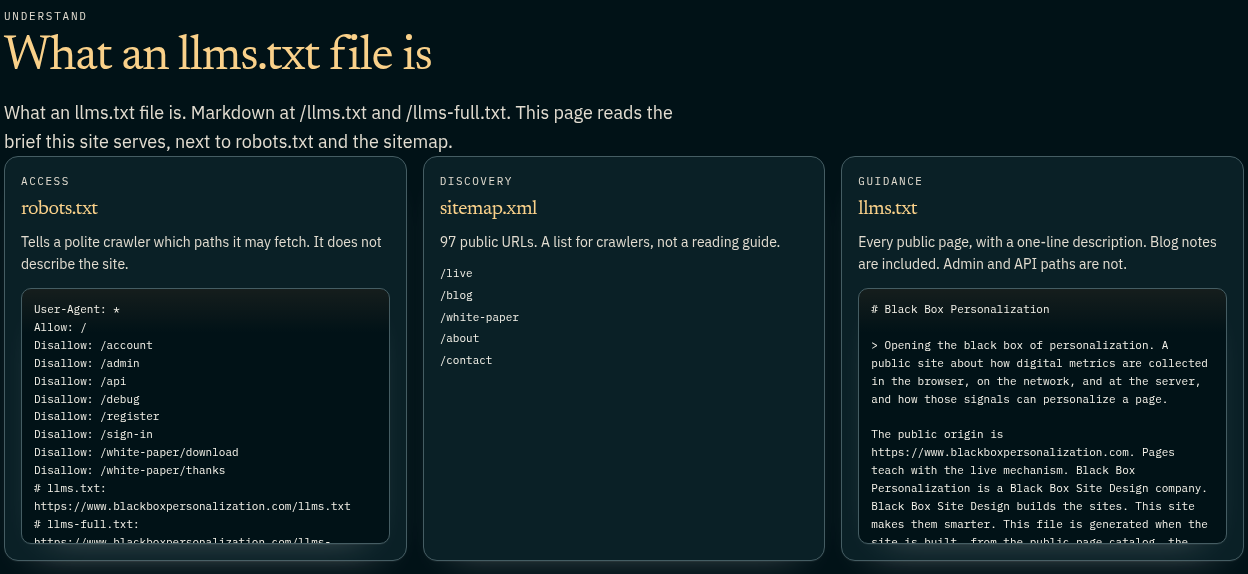
Before an agent acts, it needs a place to start. The llms.txt lab is that place.
llmstxt.org is a 2024 proposal by Jeremy Howard. A site may publish Markdown at /llms.txt so a model can begin with a name, a short summary, and a few chosen links. This site also serves /llms-full.txt, which repeats the public pages and adds a short note where a page has one.
The lab puts three files side by side, because they answer three different questions. robots.txt tells a polite crawler which paths it may fetch. The sitemap is the URL list. /llms.txt is the reading guide. Both llms files are built with the site, from the public page catalog, the lab groups, and these notes.
Which AI tools read the file is unconfirmed, and the public evidence is limited. A fetch is a fetch. The AI referrals lab logs a document request whose User-Agent matches this site’s crawler list, and the llms.txt lab shows that log for /llms.txt and /llms-full.txt.
Sense, decide, act, learn
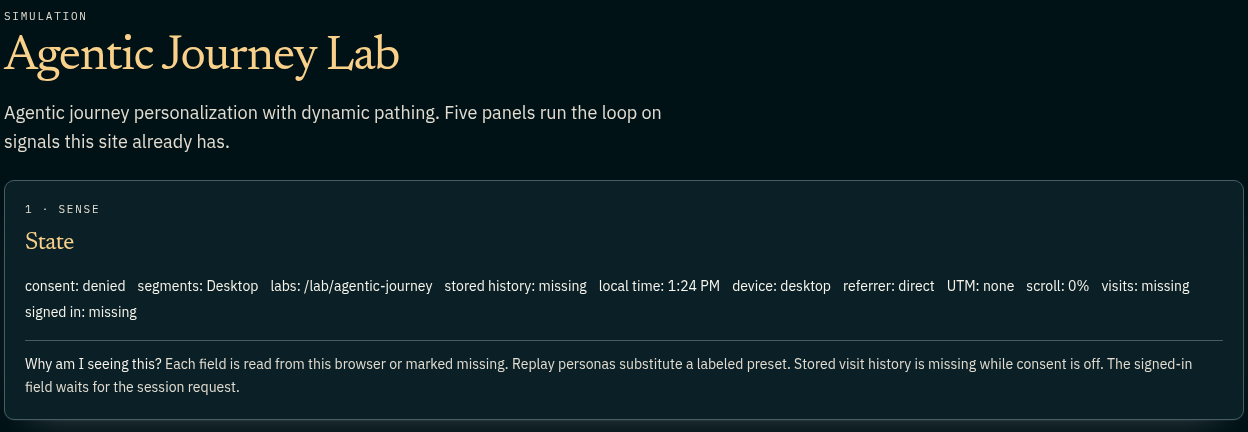
The Agentic Journey Lab runs the loop in five panels, on signals this site already has.
Sense reads this browser, or marks a field missing. Stored visit history stays missing while consent is off. Infer intent ranks four goals: the basics, measurement, personalization, or help. Confidence is that goal’s points divided by the top goal’s points. Decide path highlights one real page, and ignore, override, or a returning visitor moves the highlight. Act reorders cards only when consent is granted.
Learn is an epsilon-greedy bandit. The panel prints epsilon as 0.2. A draw under that line explores a random goal. Otherwise the highest stored reward rate wins, or the rules do if nothing has been clicked. The log stores category tokens in this browser, and only with consent. Reset my data clears it.
A sentence in, one real page out
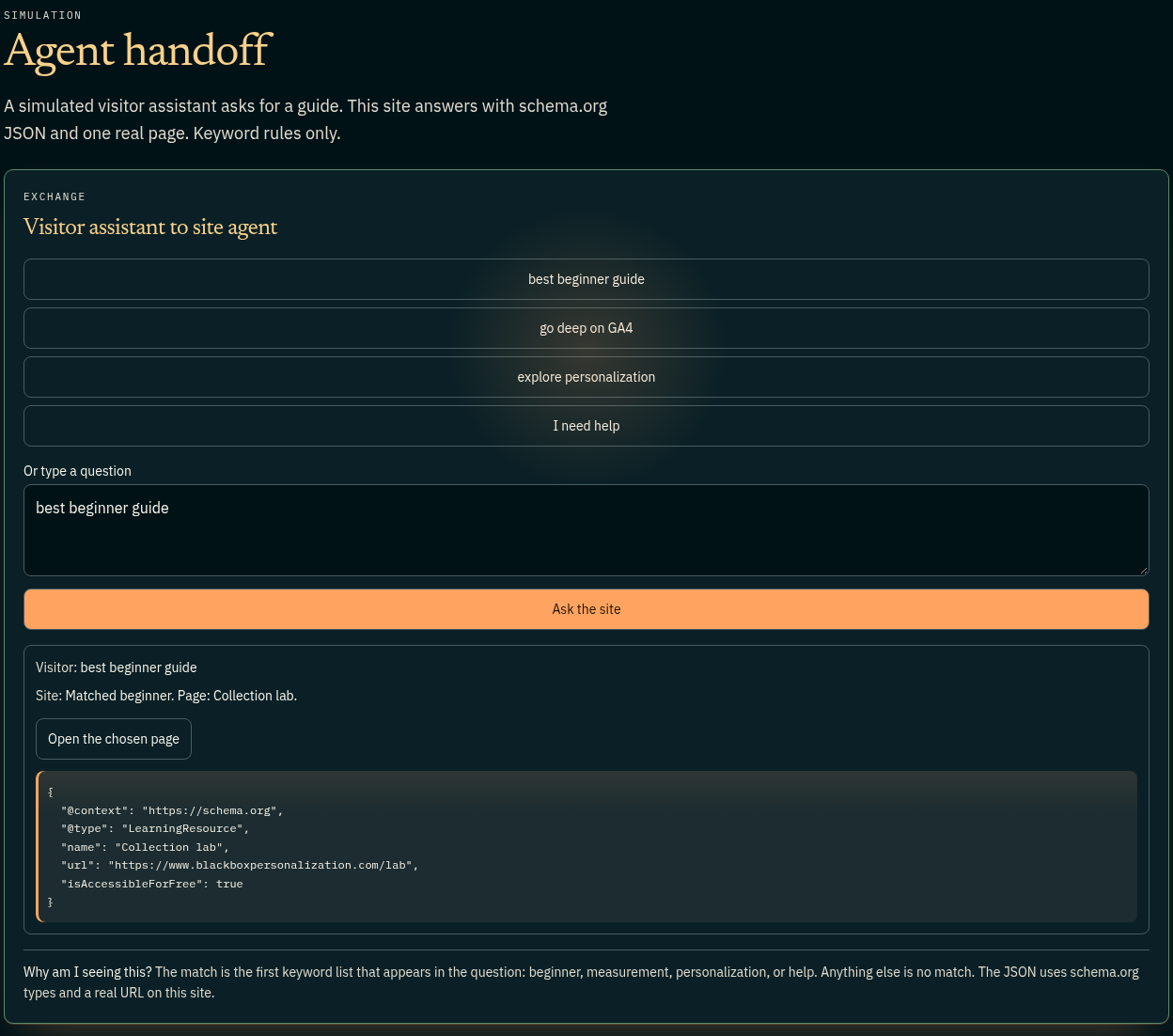
Two labs take a sentence and answer with pages that already exist. Neither one calls a model, and neither one stores the sentence.
The agent handoff lab is the short version. Keyword rules pick one page and return schema.org JSON: a LearningResource for a lab, or a ContactPage for contact. An unmatched question chooses no page. The preset best beginner guide matches the beginner list and points at the Collection Lab. Go deep on GA4 points at the dataLayer lab. I need help points at contact.
The concierge lab builds a path, and each stop names the reason. A beginner sentence goes to the Collection Lab, then the consent lab, then the showcase: consent comes before measurement, and the showcase names signals the browser already has. A measurement sentence goes to the dataLayer lab, then the server-side lab, then the consent lab. An unmatched sentence builds no path.
One nudge, and the rules that hold it back
The next best action lab offers one thing: a guide, another lab, a consult nudge, or nothing. A personalization lab already opened leads to consult. A measurement lab already opened leads to another lab. Otherwise the offer is a guide. The same action stops after two showings. Dwell under 15 seconds counts as rushed, and the offer stays back. Consent off means nothing is offered.
The friction detector watches a demo widget. Three clicks on Continue inside one second count as rage, and the page offers a simpler version. A dead control offers help. Three direction changes in the sample scroller count as thrash, and the page offers a shortcut. A field focused for three seconds with no typing is stalled. The log names the rule and stays in memory for that view.
The self-critique lab proposes an action, then fairness, sensitive categories, a frequency cap, and consent can veto it. One failed check holds the action. Inferred income and a precise place fail the sensitive check. A repeated consult fails the cap after two showings. Consent off vetoes every proposal.
The privacy negotiator shows the same boundary as a trade. Off blocks stored history and reordering. Measurement allows stored visits. Personalization allows reordering. Local examples need an extra location trade, and that trade turns off again. Sensitive categories and identity stay off. The choice is written in this browser only when measurement consent is on.
Same blocks, different order
The content assembly lab reorders four blocks: intro, proof, how, and offer. The first-time marketer preset leads with the intro, then how, the offer, and proof. The analytics engineer preset leads with proof, which points at the consent lab, then how, intro, and the offer. Nothing on the page is a measured statistic.
The goal-seeking test charts simulated traffic for two segments. Epsilon 0.2 explores. Otherwise the arm with the higher simulated win rate so far gets the next arrival. The planted rates are written on the chart.
The cross-channel memory lab walks a script: an ad, then this site, then an email, then a return. A channel class and a topic carry forward. The click id, the advertising id, and the email address stay forgotten, including on the return.
Where a model writes a line
Those ten labs are rules. A model that writes a headline lives on the AI copy lab. It opens in manual mode and fills the headline and summary from a template, using a segment and a role. The site owner can turn on AI-assisted mode with an OpenAI key. If that call fails, the template is what you see. The inputs stay next to the line.
A short walk
- Read the brief on the llms.txt lab, then open
/llms.txt. - Run the Agentic Journey Lab once with consent off and once after Accept. Act stays still until consent is on.
- Type a goal into the concierge lab. Ask the agent handoff lab the same idea in a shorter sentence.
- Open the privacy negotiator and the self-critique lab before copying the pattern onto a site with customers.
The Data APIs page lists labs that call an outside service. The llms files are generated here. The agentic labs stay in the browser and name the rule.
Labs that show this
- The Agentic Journey Lab
The Agentic Journey Lab is a transparent simulation of sense, infer, decide, act, and learn. Rules and an in-browser bandit. No model calls.
- What an llms.txt file is
What an llms.txt file is: an emerging convention, not a standard. This site builds /llms.txt and /llms-full.txt at build from its pages, labs, and notes.
- A site agent answers JSON
A simulated visitor assistant asks this site for a guide. Keyword rules return schema.org JSON and one real page. No model call and nothing is stored.
Recommended next
Why these picksReading path transitions…